Author: samanthabock

Why I Don’t Agonize Over the News (And I Don’t Feel Bad About It)

Thanks to a tip from my sister-in-law, my husband and I have been watching NBC’s The Good Place lately. (It’s funny and I highly recommend—catch up on Netflix and Hulu).

Minimizing any spoilers, there’s some conversation in the show right now about how difficult it is for people to be good in the modern world. The simplest parts of life are so complicated and global that even our smallest choices can have drastic consequences—whether we see them or not. One episode used an easy example: simply buying a tomato at the local Piggly Wiggly might mean you’re inadvertently supporting pesticide use and unfair working conditions in communities far away.

Too true. Modern life is stressful, isn’t it?

You wonder if each item of clothing you buy was crafted by a child forced into hard labor. You wonder if your eggs were laid by chickens living a bleak life on factory farms. You wonder if your preferred brand of baby shampoo contributes money to a non-profit organization you deeply dislike. You wonder if your charitable donations are going to the cause itself or just lining executives’ pockets. You wonder if the homeless man asking for your spare change might turn around and spend it on drugs. You wonder if you’re poisoning the water table by using bleach on a stubborn stain.

You wonder and wonder and wonder.

The guilt is everywhere, isn’t it? Certainly it’s on Facebook, where everyone shares idealist memes and posts pictures of their creative protest signs and “5 favorite ways to live more sustainably.” It’s on the news, garish in its display of the very worst of what’s happening in the world (giving no attention to the many, many good things that happen every minute of every day) and haranguing us for the violence and injustices of society. It’s probably in your family or groups of friends, where everyone has an opinion to share. And it’s always on your heart, making you question your choices in the quiet moments, when everything you’ve done wrong in a given day replays across your mind’s eye.

But the thing is that your life, that beautiful and complicated thing with all its individual struggles and triumphs, is stressful all on its own. Justifiably so.

You worry about earning enough to support your family, or supporting your burnt-out spouse in his or her zealous efforts to do so even while you’re running on fumes at home. You worry about raising up good, happy children who will be kind to others and love themselves as God loves them. You worry about voicing the Truth, even when it makes you unpopular, and nurturing your soul. You worry about coordinating childcare, travel, school, passion projects, home maintenance, personal development, meal plans, inboxes, outboxes, taxes, and extracurriculars at the same time, all the time. You worry about managing calendars and maintaining relationships and being fully present for the people you love even when you have a million other things on your mind.

You worry and worry and worry.

There’s just so much on your plate.

I have an unpopular opinion to confess, and I’m sharing it in the hopes it helps other moms feel less guilty when they simply can’t keep up with it all.

I don’t watch the news and I rarely scroll through headlines. I don’t know what the latest food pyramid (is it still a pyramid?) looks like, and I don’t know who’s up for a Nobel Peace Prize or why. I don’t run into every debate I come across to evangelize aloud to my peers. I don’t inspect every ingredient list or research every brand I buy. And most of the time, I don’t feel bad about it.

For a time, I tried to do these things. I tried to keep up with the intricate goings-on of the big, wide world around me, to see the many unseen consequences of my actions and take more ownership of those consequences.

And can I be honest? It was depressing. There was so much bad right in front of me. It left me feeling downtrodden and defeated—beaten down by the many sad realities we’ve made for ourselves in this very flawed world.

What’s worse was that it stole my optimism from me. I believe very deeply that we are all made to be good—we are all given an indelible soul and created in the image and likeness of Love itself. We are all God’s children.

Chasing every negative strand down its inevitable rabbit hole made that so much harder to see. No one was covering the happy things, and I was losing the forest for the trees.

Beyond all that, I was simply running low on time. My kids needed me. My husband needed me. My home, job, and extended family needed me. I needed me. I needed to invest in those things, and the additional time and energy had to come from somewhere.

So I don’t feel obligated to pull the thread of each and every decision I make, testing to see how thoroughly my positive intent unravels into a net negative effect. And I don’t think you should, either.

Now, don’t get me wrong. I don’t live a life of carelessness or solitary self-interest. I buy organic for many grocery segments and have a personal commitment to free-range eggs. I avoid some of the more blatantly irresponsible brands (which, often, are too expensive anyway). I donate items instead of trashing them, I recycle, I buy secondhand where it makes sense, and I teach my toddlers not to be wasteful. I’m trying to prioritize cleaning and self-care products that feature natural ingredients. I donate to people and causes in need. I tell the Truth and live it in full view of my neighbors. I am not blind to what’s happening in the world my children will inherit.

But these are choices I make in an effort to care for my family more responsibly. They aren’t hard rules I punish myself for breaking or hold against others who don’t share them.

We live in a very big, very troubled world. And the reality is that we are each a brief blip on the global radar. For most of us, it will be difficult—if not impossible—to have an influence so notable that our names will be recorded in history books.

But do you know what part of your world is very small and very impressionable? What part of your world is fundamentally influenced by you and the choices you make?

Your family.

I think Saint Teresa of Calcutta said it best. Upon winning the Nobel Peace Prize, she was asked how we can promote world peace. Her response? “Go home and love your family.”

If marriage and parenthood are your vocations, the ripple effect of your influence on the world—named or not—begins at home. It begins with the love you share with your spouse and the love you instill in your children.

So be a good citizen of the world, but do not obsess over the world or its affairs. This world is not your home.

“Do not be conformed to this world, but be transformed by the renewal of your mind, that you may prove what is the will of God, what is good and acceptable and perfect.” – Romans 12:2

Relativism and the Erosion of Truth

We are creatures of need.

At our most basic level, we must eat, drink, seek shelter, stay warm. A little higher up on this hierarchy of needs, we must feel safe from violence and secure in our pursuits. Above that there’s the need for social belonging. Next is respect: we crave the recognition of others and, more importantly, positive self-esteem. Finally, there’s self-actualization: the point at which we realize our full potential.*

Most of us would recognize these needs as simple truths, and it’s obvious that the higher you climb on this pyramid, the more difficult it is to meet each need. Achieving each is dependent on securing the previous, and so life becomes an arduous endeavor for fulfillment.

In our lifetimes, we develop tactics for meeting those needs as best we can. Sometimes we do things right: we prioritize properly to set and achieve positive goals. Other times, we choose shortcuts: bad habits that provide quick satisfaction in lieu of putting in the work to reach big-picture fulfillment.

Relativism—the view that there is no objective right or wrong, and that each of us can decide the truth for ourselves—is our culture’s shortcut. It’s how we bridge the gap between what we should do and what we want to do, without facing the challenges inherent to the disconnect that sometimes exists there. In fact, it’s how we convince ourselves that there is, in fact, no disconnect. Because how can you claim that anyone should do anything when there’s no Absolute Truth at all?

*Abraham Maslow, the American psychologist who developed this framework, later went on to say that “self-transcendence”—in which we pursue some higher, altruistic, spiritual goal, outside of ourselves—is the actual penultimate dimension of need. Ironically, Maslow was an atheist. But doesn’t this theory establish the importance of faith? What better way to explain, in secular terms, why the pursuit of God’s will is the natural end to which our everyday behaviors must be the means?

Cognitive Dissonance

To dig into this further, we need to understand that our minds are averse to what we call cognitive dissonance. In a way, this means that we want our beliefs and behaviors always to be in harmony.

For example, say you believe that “people with anxiety are weak.” But then your sister—who has overcome some immense obstacles, including raising a child with extensive medical needs—confesses to you that she’s been seeing a therapist and has a prescription for Xanax after a recent, debilitating bout of panic attacks. Deep down, your reactive behavior is to judge her: Wow, and here I thought she seemed so together.

On some level, though, there’s a disconnect here that would bother you: How can I judge my sister as weak when I know her to be strong? How can someone so strong struggle with a condition that afflicts only the weak? Your mind would want to correct it, likely via one of three tactics:

  • #1: Fundamentally changing one or more of your relevant beliefs (e.g., accepting that anxiety affects even very strong people, or that your sister is actually a weak person);
  • #2: Gathering new information that reduces the dissonance by outweighing, or objectively disproving, your original belief (e.g., discovering scientific research showing that, in fact, even very successful and otherwise happy caregivers are commonly afflicted with anxiety disorders); or
  • #3: Reducing the importance of your original belief (e.g., realizing that you shouldn’t care at all about how weak a person with anxiety may seem—it’s not your business anyway).

Arguably the most difficult of these methods is the first one. To change your belief that anxiety is for the weak, you’d have to abandon your own paradigms and cease the automatic way in which you judge a man who is too nervous to drive a car (Can’t he just suck it up and run his own errands?). To change your belief that your sister is strong, you’d have to somehow ignore the years of first-hand interactions with her that have made her resilience obvious.

It’s not easy to completely overturn our fundamental beliefs or habitual behaviors. It’s one thing to convince yourself that perhaps you didn’t know enough about a subject (tactic #2) or placed too much importance on it (tactic #3); it’s quite another to admit that you’ve been outright wrong all along.

Of course, in this example, the mental exercise of correcting dissonance can have a positive outcome: it can help us overcome negative stereotypes and become more understanding of the people around us. But this instinct for mental harmony can also become a crutch that helps us subvert our core belief systems.

Dissonance Between Friends

Now, let’s look at a conversation which commonly ends in some pervasive, relativistic platitude like “that wouldn’t be right for me, but it’s not my place to tell you what to do.”

Say Timothy and Vince are good friends. They’ve known each other since high school, and are now in their late forties with good careers and healthy families. Both attended church together as teens, and they were married in that same church just a couple of years apart. Timothy comes from divorced parents who fought viciously during their separation; his relationship with his father, who virtually disappeared from his life after the legal battle, has never been the same. Vince comes from a traditional family and his parents, who have both died, were together for 40 years.

Vince invites Timothy out to catch up; it’s been a while since they watched a game together. During a commercial break, Vince surprises Timothy with a confession.

Vince: “So Jane and I have decided to see other people.”

Timothy: “Oh, wow, man. I’m sorry to hear that. Have you decided who’s going to keep the house?”

Vince: “No, no, it’s not like that. We’re going to stay together because she’s not working and can’t afford to move anywhere on her own, plus keep the kids. We’ve just sort of lost interest in each other, and this seems like the simplest solution.”

Timothy: “Huh—I see. How did all of this come about? How did you guys even start that conversation?”

Vince: “Well, it’s an old story, I guess. There’s this new attorney at work and she made me feel like a hound again, you know? I haven’t felt like that in ages. It wasn’t long before things between us were getting heavy, and Jane found some text messages on my phone. I came clean right away; told her I’ve just been feeling like things between us weren’t really working anymore. I asked her, ‘Why waste time feeling unhappy when we could try something new? Life is short.’ It’s not like we’d even touched each other in months. There was just nothing there. She was real quiet but didn’t put up a fight. She didn’t want to figure out how to go back to work, and I didn’t want to miss out on the kids, so I told her we should just stick around but do our own things.”

Timothy: “Jeez. And she was okay with all of that?”

Vince: “Yeah. I mean, she hasn’t said no yet. So far neither of us has voiced any complaints. The kids don’t have to find out. And this way Jane doesn’t have to worry about me anymore. We can just take charge of our own lives and keep living together like we always have. We’ve basically been like roommates for a while anyway. Why not make it official?”

Timothy: “Wow. Well, I could never do that, but I hope it works out for you, man.”

What thought process might Timothy be trying to cycle through here? Let’s break it down.

Timothy has always seen Vince as someone who was committed to his family; his kids go to private schools and have big college funds, he was never an excessive workaholic, and his wife always seemed happy that she could stay home and spend time with the kids instead of having to work full time like Maggie, Timothy’s wife, does, to help make ends meet. Vince went on and on at his bachelor party about how much he loved his bride, and he didn’t do anything sketchy there and hasn’t since (until now). Plus, according to Vince, Jane was fine with it. She was going along with the arrangement “without any complaints.” And maybe it was better for the kids that their parents would still appear together, and not fight in court for the next several years.

Still, things aren’t really in harmony here. Timothy believes that parents who leave marriages tend to miss out on the closest possible relationships with their children (like his own dad did). He also believes that marriage is precious, and that it shouldn’t be entered into—or set aside—lightly (especially after seeing his mom suffer through her divorce from his dad). Finally, he believes that Vince is a good provider for his children, and that he genuinely appreciates his family. But he’s not seeing these beliefs line up, given Vince’s choices.

Timothy can try to respond to this dissonance in a few ways:

  • He can acknowledge that Vince’s behavior doesn’t match up with Timothy’s belief in him as a good family man, thus making a new judgment that Vince’s moral framework no longer matches his own (the consequences of which could involve losing Vince as a friend, or confronting Vince about his actions);
  • He can tell himself that his understanding of marriage and why it’s important for a family’s foundation is too narrow, and can be broadened to include the co-parenting and co-habitating arrangement that Vince is describing (after all, it seems to be working for Vince so far, and Vince has more exposure to healthy marriage than Timothy does, given their parents’ situations); or
  • He can reduce the importance of his opinions altogether (because aren’t they just that—opinions?), and choose to believe Vince when he says he isn’t harming anyone and should be able to make his own decisions.

Which of those options sounds like it involves the least mental and social gymnastics?

Who Am I to Judge?

Relativism so quickly takes root in us precisely because that last option is easiest.

It’s incredibly difficult to confront—or, worse, lose—a friend over a personal and tender subject like this. It’s difficult to change our own beliefs across the board, based on the possibly sketchy experiences of another person. But it’s not that hard to think ‘It’s none of my business,’ and simply ignore some potential red flags, because we’d rather trust our friends and maintain the status quo.

Taking that one step further, it almost seems like the better way to operate, doesn’t it? Relativism seems like a perfect way to “live and let live.” We don’t get in other people’s business, and they don’t get in ours—we simply coexist. Why shouldn’t we accept our differences of opinion, and choose to live and work beside our neighbors without deigning to think our choices are more valid than theirs?

In truth, though, taking a relativistic stance is not an act of love. It’s an act of cowardice.

Edward Sri, in his book Who Am I to Judge? Responding to Relativism with Logic and Love, summarizes this truth well: “Relativism … divides us. It trains us to focus on ourselves and ignore the people around us—what they’re going through, how they’re living, and ways they might need our help.”

relativisim quote 1

Thus, relativism becomes a philosophy of self-centeredness. Sri goes on: “In many ways, relativism paralyzes us. So we sit back and do nothing, and let our friends and relatives damage their lives.”

The neglect goes both ways. Don’t we all believe that the people we love help make us better? But how can they if we demand their apathetic, unconditional acceptance of even our worst behaviors?

A New Normal

Sri’s book discusses how relativism dominates our current culture, why it came to be that way, and how we can confront it. The short of it is that we’ve traded the classical moral code for a new one—one that can be summarized as “minding your own business.” Because, Sri notes, despite a common refrain to the contrary, relativism does call us to project an ethical framework onto others:

At first glance, [relativism] seems like a good way to promote tolerance of diverse views. But we must understand very clearly that relativism, in fact, is not value neutral. Relativism itself is a certain way of looking at the world. And this view—that there is no right or wrong—is being imposed on us. In other words, the belief that there is no moral truth is itself a point of view. And those who do not agree with this relativistic perspective are being forced to play by its rules or risk being labeled as judgmental if they uphold traditional moral values. (emphasis original)

Joseph Ratzinger—also known as Pope Benedict XVI—also talked about this trend in Without Roots: “The more relativism becomes the generally accepted way of thinking, the more it tends toward intolerance, thereby becoming a new dogmatism. … It prescribes itself as the only way to think and speak—if, that is, one wishes to stay in fashion. Being faithful to traditional values and to the knowledge that upholds them is labeled intolerance.” Ultimately, he concludes, “I think it is vital that we oppose this imposition … which threatens freedom of thought as well as freedom of religion.”

As Catholics, we live tenets of faith that are often unpopular at best, and ridiculed at worst. We believe in the utmost respect for life at all stages, despite circumstances that may make this position inconvenient or painful. We believe in sexual ethics as the truest expression of love and fulfillment of God’s design for men and women. We believe in the True Presence of Christ in the Eucharist. We believe in doing good for our neighbors. We believe in setting aside materialism. We believe in our obligation to pursue, respect, and submit to the sacraments in many facets of life, remaining loyal to the Mass, to marriage, to confession, to religious life.

All of this means that we believe in a moral framework that cannot be boxed in as a relative truth. It is universal. And it is our responsibility to live and defend it at every opportunity, with kindness and firmness, within our Church and outside of it.

This is, sometimes, an intensely difficult responsibility. Some of us are better at it than others. (I’ve always been the “live by example” type myself, often choosing the easier route of simply living by this moral framework in the hopes that I will influence others subtly—and deftly avoiding direct confrontation at all costs. Not the bravest form of evangelization, I admit.) But no matter how we do it, it rarely makes us popular.

There are few more efficient avenues to the erosion of truth than the relativism that dominates popular thinking in our communities. By trying hard to swim up that stream and resist its pull, we are not pushing away our neighbors—on the contrary, we’re trying to bring them home. And we are not lifting ourselves up as “better” people—just hoping for a better world in which our own children can grow well.


 

Lessons from the Babies I Never Met: What ‘Fiat’ Really Means

This is the third part in a three-post reflection on miscarriage. I wrote this post a few months ago, shortly after our second miscarriage—when the wounds were still fresh. I wasn’t ready to publish it right away, but I’m publishing the whole series now, in October, in recognition of National Pregnancy and Infant Loss Awareness Month. Read part one and part two.

I had a second miscarriage this year. I was eight weeks along with identical twins. I lost them at home after days spent convincing myself everything would be okay.

We conceived this pregnancy immediately after our early loss with Gabriel; our doctor told us there was no reason to wait, and we missed that baby and were hoping that welcoming another would help us heal. It was rejuvenating to be pregnant again, but I was so scared. My tests were dark; things seemed fine. I had a good feeling about this one. I felt healthy and pregnant and maternal. I took good care of myself, with a better diet and more mindful exercise than usual. I was settling into another pregnancy.

At eight weeks exactly, I started spotting. I immediately panicked, though it was light, and headed to the ER. Four hours later, with my husband at my side, I heard “It’s twins” from the ER doctor. I don’t even remember how she phrased it; I just remember the shock and worry and awe.

We had a small subchorionic hemorrhage—a bit of bleeding at the implantation site. It wasn’t a major concern, but it was causing the bleeding I’d been seeing and would need to be checked again soon. That was the good news.

The scary news was that the twins appeared to be mono-mono: they shared a placenta (mono-chorionic) and, more frighteningly, they shared an amniotic sac (mono-amniotic). Worse, their heartbeats were slow: only 83 and 87 beats per minute, when eight-week babies should have heart rates well above 100 bpm.

The ER doctor seemed unconcerned, but Erik and I knew these were not good signs. I called my regular OB on the way home from the hospital, and she was not optimistic: mono-mono twins were incredibly risky and most often had sad outcomes. The potential of our babies becoming entangled and cutting off one another’s connections to their shared placenta was high. She told us to expect a high probability of miscarriage or life-threatening complications down the road, if the diagnosis was confirmed.

Erik and I were devastated, but tried to remain positive. We did our own research and discovered that mono-mono structures are often misdiagnosed so early. My bleeding became a bit lighter. We had plenty of reason to expect to welcome twins in seven short months (or less). I wondered how we’d tell our families.

But then the bleeding picked up again. And then I had some pelvic discomfort that felt unsettlingly like a period. And then my babies were gone from me.

My doctor—who must see this type of tragedy on a horrifyingly regular basis—told me, when I called in tears, that there was nothing we could do but wait and see, and confirm with a follow-up ultrasound on Monday (two torturous, long days later).

I understood this. I knew that it would be more merciful on our family to stay home and mourn. I knew that, if it was such a high-risk pregnancy, it likely would only have been terribly difficult and painful as we moved to the more advanced stages of pregnancy. But that didn’t ease any of the pain.

My husband and I wept. I hid in our bedroom for hours. I skipped meals and ate ice cream when hunger snuck up on me. I tried to accept what I knew, deep down, even though some small part of my mind wondered if I might still have just one of those babies with me.

On Monday, the doctor told us that my womb was empty of anything valuable—just a bit of blood remained. This was good news, she said, because I’d passed everything naturally and wouldn’t need any further procedures. But I felt barren. Empty. Crushed.

We contacted our parish and set up a funeral for the Fourth of July. The deacon and priest presiding graciously included Gabriel along with the twins, now named Karol (after John Paul II) and Julian (after Julian of Norwich). We still don’t know if our babies were boys or girls. We won’t until, someday, God willing, we meet them beyond Heaven’s gate.

We buried them. We picked out a headstone. We accepted that our summer would be empty of pregnancy hormones and a round belly and expectation. We accepted that we could not tell our daughter that she had more siblings on the way. We realized our son would see his second birthday before he met a new baby brother or sister. We began to understand that, in the most profound way we’d ever experienced, our plans did not match up with God’s plan for us. It has been a frightening revelation.

But we have chosen to say “yes” to His plan. We, though drowning in the sorrow of lives lost and babies unmet, are clinging to our faith in God to carry us through. We have no idea of the consequences of these events, but we have given our fiat to the Father and accepted that His will is greater than ours.

Inspired by Mary (who gave a truly categorical “yes” to God when the archangel Gabriel visited her), I have done my very best to say to God: “let it be done to me according to Your will.” I am trying to recognize the simple truth that I have very little control over this world and my place in it. I am human and I am small; but God is love and He is great. He would not abandon me. He would not wish sadness upon me. This suffering is not His doing—it’s the sad fact of a broken world, and He only wants me to get through it. He can sanctify me through this pain. And I can only cling to His love and trust His will as I seek healing.

Like the Blessed Mother, I hope that saying “yes” will help me find the grace that I need to see me through these trials. Mary’s path, though she was chosen for such a beautiful gift, was wrought with suffering and confusion. She bore the Holy Infant, and her role in the Savior’s early life was center-stage—but then she had to say goodbye to him in the most painful way imaginable. She had to watch her only son persecuted, abused, and ultimately killed by people for whom he had only boundless love.

My babies knew no pain. They did not see the sin of this world or the folly of its inhabitants. They left the warm embrace of my womb to be nestled in the warm embrace of God. For their peace, I am thankful. I hope that I can share in some small part of it.

Lessons from the Babies I Never Met: Trust

This is the second part in a three-post reflection on miscarriage. I wrote this post many months ago, shortly after our first miscarriage—before we were devastated by another. I wasn’t ready to publish it right away, but I’m publishing the whole series now, in October, in recognition of National Pregnancy and Infant Loss Awareness Month. Read part one here and part three here.

I had a very early miscarriage this year. So early my doctor called it a “chemical pregnancy.” I was not quite five weeks—there was no chance to see anything on an ultrasound. All the proof we have of that baby was a week’s worth of positive pregnancy tests and a heartbreakingly low, but definitive, blood hCG level. That, and the ache in my heart, and in my husband’s heart, at the baby’s absence now.

That baby matters. Still matters, even though he or she is no longer with us. Even though we never knew him or her. Even though he or she never got to physically feel our love or see the world.

I was home to that baby for a few short weeks. Just as I was home to two children before who, by the grace of God, have grown into the beautiful kids playing in the other room right now. This baby was their brother or sister—a little soul who will forever be a part of our family. This baby matters.

A life so young is difficult to detect. My body knew before my mind and before any test could’ve known. I was particularly thirsty because that baby needed fluids. I was extra hungry because he needed fuel. I had to pee more often because he needed a clean place to grow and my body was working overtime to prepare it for him. I could smell everything because it was my job to keep him away from danger.

I was nervous from the beginning. It took several days longer to get a positive test, compared to my first two pregnancies. And when the tests were positive, they weren’t as dramatic as I wanted. But after a week of steadily, if only slightly, darkening tests, I decided to let go of my anxiety. I joined a due date group on Facebook. I signed up for a new pregnancy app. I found myself touching my belly without thinking. I talked to my new baby. I believed.

And then, just a day or two later, it started. Just a little, at first—enough that it might be okay. But then it was more than that and my doctor told me “this doesn’t sound like a normal pregnancy.” A blood test the next morning confirmed that it was over.

I know God brought this baby home early because this world was not what was best for him. I am thankful that there weren’t any complications for either of us. I am thankful that everything happened so fast, because if it had gone on any longer I don’t know what I would’ve done. But I miss that baby and I wish I could’ve been a better home for him.

We will never—or not in this life, anyway—know if our third child was a boy or a girl. I find myself imagining a boy, so that’s the pronoun I generally use. My husband suggested the name Gabriel; it’s masculine but can be feminized, so it’s neutral enough. The angel Gabriel brought the most profound news to Mary centuries ago. It seemed fitting.

Gabriel will always be a little saint to us; someone who can pray for our family forever and always. We are thankful to have had him, even for such a short time. I will always ache when I think of him, wishing I could’ve been his mother in more numerous and more mindful ways. But I am thankful that God chose me for him, and that I’ve learned so many important lessons from such a devastatingly brief gift.

Gabriel taught me not to take motherhood for granted. It was blessedly easy to bring our first two children into our lives, but I will never again make the mistake of thinking it must be easy to do it again.

Gabriel taught me that I need to learn to make trust a bigger part of my faith. There is no peace without trust in God—or acceptance that I am not in charge of anything, really, in the grand scheme of things. Ultimately, I know it would be a lot harder if I was in charge.

Gabriel taught me what a difference prayer can make. When things started looking scary, we reached out to a handful of people to ask for prayers and support—even though we’d been keeping the pregnancy a secret, as we usually do early on. I sought prayers from many friends in online mommy groups, a safe way to share my fear and sorrow and receive gentle words in return. Almost immediately, I started to feel a little more at peace. I was and am still heartbroken, but those prayers helped me find a little warmth in a cold landscape of loss. That small comfort meant the world to me.

Gabriel taught me that life does go on. There are a lot of things going on for my family right now; we thought we couldn’t handle any more. And then we lost him. But we are still here, and we have children and family and friends who need us. So we must go on, memorializing Gabriel as best we can and honoring him in our own small ways. We are changed, but the world still spins. I wasn’t sure I could handle something like this. But then it happened to me, and I had no choice.

Gabriel taught me that my voice is important. He never had a chance to speak for himself—to announce his presence to the world. But I can make sure his life, though brief, is felt by others. I can use my voice to make sure he is known. And when I suffer over this loss, I can use my voice to ask for help.

Gabriel taught me to lean on my spouse. I wanted so badly to shield my husband from this pain—it broke my heart all over again to see his face when I told him what was happening. But it has felt good to find shelter in him. To know that we’re in this together. It was our love that brought this baby into our family, and in our love we have said goodbye.

We are still thinking of the best ways to remember and honor Gabriel in the long term (if you’ve been here and have suggestions, I’d greatly appreciate hearing whatever you’re comfortable sharing). But for now, these many lessons from him are precious gifts that I will cherish forever. I love you, Gabriel. I miss you. Someday I will hold you in my arms.

Lessons from the Babies I Never Met: Motherhood Evolves

This is the first part in a three-post reflection on miscarriage. I’m publishing these in October, in recognition of National Pregnancy and Infant Loss Awareness Month. Read part two here and part three here.

For the first time in more than three years, I am neither pregnant nor breastfeeding. It seems like it should be a time to rest and get back to myself. But it is not a break I’ve taken by choice, and I’ve struggled with it immensely.

I had expected to continuously share my body with my children during this season of my life. At first, it was draining—but then it became my groove. I felt strong, knowing my babies depended on me so fundamentally. I felt active in my mothering—capable. It became part of my identity and I didn’t even know it.

My husband and I have hoped for four children and planned to space them tightly. We want them to be close, we want to have them while we’re young and it’s easier on our bodies, and we want to tackle the “baby years” all at once. But life has not gone according to plan. Turns out it’s not really about what we want.

We have five children; only two of them are here with us. Two back-to-back miscarriages this year (including a set of twins) meant we never got to hold our youngest babies.

After we said goodbye, I was so lonely in my own skin. I was longing to feel a life alight within me. I felt empty. Intellectually, I know I am not alone—I have a family who is wonderful in every way, and a husband who would do anything for me. I have two beautiful, healthy children with me each day. But it’s been years since I wasn’t physically connected to my children in some way. And it’s lonely, to not have that anymore.

New motherhood is so primal—so deeply physical. It begins with an overwhelming sense of awe that your body, all on its own, is so ready for something you don’t yet even understand. My body knew instinctively how to be a mother long before my mind made the leap.

Since my miscarriages, I’ve had to learn to trust that my mind—and all its slow adjustments and stress and erratic feelings—is enough for the children I have here with me. But I’ve also learned that my body is as much comfort for them as it’s always been.

I hold their hands. I kiss their ouchies. I snuggle them when nightmares wake them in the night. I change diapers. I show them how to perform increasingly complex tasks on their own, so they can grow into kids and adolescents and adults who can hold their own in the world. I am present.

I know now that a mother’s love is always as physical and visceral as it is emotional and spiritual. This is true at every stage.

Despite the pain, I am immensely thankful for my little saints: Gabriel, Karol, and Julian. And I am glad to know they are praying for our family; that they love us and know they are loved, too. I am also thankful for the opportunity to work with a NaProTechnology doctor who does not discount our losses as “bad luck,” but is supporting us with mindful care to give us the best chance of holding our next baby.

October is National Pregnancy and Infant Loss Awareness Month. I’m sharing this story today because we don’t want to keep our babies—tiny as they were, briefly as we knew them—a half-secret anymore. I’ll publish a few blog posts reflecting on them in the coming days, to honor them and make them known. They deserve to be known.

If you have suffered from an early loss, like me, and have no one to talk to—please know that you can talk to me. No matter how well we know each other, no matter how recently it happened. If you need a listening ear, or a prayer, or commiseration, or distraction, please don’t hesitate to drop me a line. We are all in this together.

Babies Gabriel, Karol, and Julian—pray for us. I miss you.

Why It’s Gotten Harder to Be A Good Wife

I’ve always (even before I had any business forming an educated opinion on such things) thought that, in the context of a family, a husband and wife must prioritize their marriage above all else.

A marriage is the foundation of a family. Even once children come into the picture and demand (and deserve) so much time, love, and energy, Mom and Dad can’t lose touch with one another in the busyness of everyday living. They must work well together as a team to ensure the happiest home for those children, and they must remain close even after their children leave the nest.

Actually being married and having babies has taught me that this really is the best path toward a happy, fulfilled family. It’s also taught me that, some days, it’s a lot harder than I expected it to be.

Changing Seasons

My husband and I have been together for a long time. Since we were high school sweethearts, many of those years were spent before marriage and kids came along. I won’t say those years were easy, but I will say that the blind optimism of young love did us a few favors. When you’re right for each other, young, and susceptible to fairy tales, it’s very possible to stubbornly forge through a struggle simply because you’re confident “happily ever after” is just over the horizon.

Our newlywed years were joyful. It was a long-awaited privilege to wake up together each morning and come home to each other at night. And it was easy to take on the world together.

When our first child was born and I felt the shock of taking on a new identity, my husband was my resting place. He gave me confidence and reassurance when I was unsure of myself. His fatherhood made my motherhood manageable. We had no problem tackling parenthood as a team, and so we had no problem nurturing our marriage just as diligently as we nurtured our beautiful daughter.

I’m not proud to say this, but when our second was born, that story was different for me.

Physical, Emotional, and Spiritual Effort

I’ve tried so hard to understand this struggle in order to resolve it, and it’s very difficult to pin down. But I’m going to try.

When my first was born, I had a period of confusion. I knew motherhood was in my bones—I knew it was what I was meant to do. But that didn’t mean it was automatic or easy to absorb that new part of my identity. My thoughts were suddenly dominated by a tiny person and how to order every one of my waking moments around her needs. For a time, I had trouble grasping what part of “me” was left after so much of my focus went into motherhood.

My husband helped me feel like the “me” that I recognized. Our marriage was an anchor to the “before kids” part of our life, and I needed that to stay grounded as I navigated our new normal. After a few months, we all settled in quite happily.

Still, as we prepared for our second to be born, I was thinking this same thing was going to happen: that I would have to learn all over again how to be a mom.

It turned out not to be quite so earth-shattering. My soul is happy and fulfilled as a mother, and I’ve settled into that identity well enough that adding a second child meant adjusting routines and habits, sure, but not another reinvention of myself. It was a happy surprise.

However, those new habits and routines did take a lot of physical energy, and the adjustment took plenty of emotional energy, too. It’s difficult to hear two children screaming for you when you can only lift and comfort one at a time. The sleep exhaustion that comes with a baby who dislikes falling asleep plus a toddler who’s not feeling well is profound. The list goes on.

So while I felt more at home becoming a mother of two than I did becoming a mom of one, I was physically and emotionally drained by caring for two kiddos. It is hard. I am generally happy, but I am tired.

As a result, when both kiddos were finally, (relatively) reliably asleep come 10:00 p.m. and I had my first chance of the day to do something without needing to cater to them first, all I wanted to do was cater to me. What energy I had left I wanted to hoard for myself. I didn’t want to use it up by asking my husband how his day was or helping him with a project.

Now, naturally, there’s going to be some period of survival after a baby is born. It’s a time to do what you can, set aside what you must, and learn to be okay with that. You make sacrifices. You must. But that doesn’t give me permission to be selfish with every spare minute. I am part of something bigger than myself, and I can’t function as an island—nor should I expect my husband to be satisfied with life on an altogether different island.

Give and Take

It may be unavoidable that our needs take a backseat to the demands of two small children, but it’s not unavoidable that one spouse neglects another completely. And sometimes, that’s what I did.

My husband, being the kind and attentive man that he is, saw that something was wrong. He saw that I was not reaching out, and he often thought that was a reflection on him: You are distant, which means you are unhappy, which means I’m doing something wrong. But it wasn’t about him; it was on me.

Over time, I learned how to do simple things—like ask for help (duh), set aside some me-time before the kids go to bed, and pursue new hobbies—that keep my energy bank full enough to share more with him. He’s been there at every turn to do whatever I ask of him; in fact, even as I was paying him very little personal attention, he was always thirsty for ways to make my life easier and more comfortable. That’s the kind of guy I married.

I’m still working on this and am nowhere near as good as I should be (even though the physical demands have lessened as the kids have gotten incrementally older and more independent, I’ve formed some bad habits that are difficult to break). But I’m getting there.

Thoughts on Unconditional Love

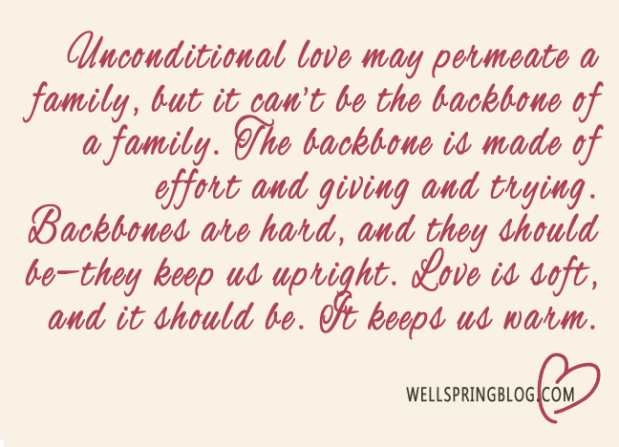
The biggest thing I’ve learned, I think, is that unconditional love may permeate a family, but it can’t be the backbone of a family. The backbone is made of effort and giving and trying. Backbones are hard, and they should be—they keep us upright. Love is soft, and it should be. It keeps us warm.

unconditional love quote

My children believe that my love is unconditional in a very real sense. They don’t question whether I will feed them, change their diapers, or be there to hug them when they wake up. A comfortable home and toys to play with are simply accepted parts of their environment. When they misbehave, they know that I will forgive them and, once any discipline is over, life will go on as if nothing is changed—because nothing has changed, really. They know that they can do whatever things their beautiful little minds invent, and I will be there to guide them through it. That is the innocence of a child. All the things into which I put so much work and prayer are taken for granted, and that’s okay.

My husband believes that my love is unconditional in a very different way. He doesn’t question whether I’ll be by his side because I’ve made vows with him, and I’ve proven my devotion in the way I’ve treated him. He counts our happy home among his greatest blessings—it’s something he knows is a gift made by us and by God. When we argue, we find room to forgive and amend our ways—and he is grateful for my doing so because he knows that I make a choice to do it, for his sake and for our family. He recognizes and appreciates my love for him at least partly because he knows that life would be so different without it. He feels it because I give it to him, not simply because it exists.

Children know the love of their parents because it is a fact of life. It is in the order of things, which they know deep down in their souls long before they could ever recognize that knowing. They know they are loved because there is simply nothing else to know.

Spouses know their love for each other because they have chosen each other: their marriage is an order of things that they have created and committed themselves to fully, without exception. They know they are loved because they receive that love as a gift.

As long as I can preserve that innocence for my children in these formative years (by giving them my best as frequently as humanly possible), they easily forgive the occasional loss of patience or the moments I need to rest instead of play. They are confident in my unconditional love because I am their mother, and that is all they need to know.

For my husband, though (and this is true for me, too), feeling loved isn’t that simple. He feels my love when I choose him: when I choose to ask him about his day or help him with a project or even just express my desire to be near him. He is confident in my unconditional love because I continuously prove that it is here for him, offering it again and again by living out my vows.

20 Songs on the Soundtrack of #MomLife

We have an Amazon Echo at home, and use it to play music during family downtime. (We listen to a little everything — from Alanna Boudreau to John Denver and Ed Sheeran to Jon Foreman — depending on who asks Alexa to play something first.) Our two-year-old asks for music almost daily now, and will happily dance around a little in between games and meals and tantrums. Even our nine-month-old will clap and bounce along when a good song comes on.

On the rare day when both kids are sleeping at once and I have a few minutes of downtime, I’m always struck by just how quiet the house seems. The hush that I once rushed to fill (looking at you, always-have-the-TV-on-even-just-as-background college years) is now equal parts peaceful and bizarre. It gets crazy and I’ve probably suffered some amount of hearing loss already, but I love the chatter of my kid-filled house these days.

So here’s a fun little post for a Monday. In no particular order, these are the sounds of my daily life. Too bad most of them aren’t particularly good for dancing (except maybe #13, depending on your settings).

1. Screaming.

So much screaming.

2. Embarrassingly loud, public baby farts.

Loud enough to make you and your husband look at each other and whisper, “Was that just a fart?”

3. Giggling.

Melts your heart every time.

4. The slamming of little feet all over your house.

Whoever called it a “pitter-patter” had poor language skills. (It’s still cute, though.)

5. Breakable items falling from their careful perches.

Another one bites the dust.

6. Tearing paper.

Why do they rip all the paper?

7. Pudgy little limbs running into furniture, walls, and so on.

Followed by “You really should watch where you’re going, honey.”

8. “Pleeeeaaaaaaaaaaaase?”

Sometimes it’s cute. Sometimes it drives you crazy. Context is everything.

9. The scrape of furniture and/or toys along your new hardwood floors.

I don’t even care anymore.

10. Coffee percolating.

Why does it take so long?!

11. The oven/microwave/Crock-Pot timer chiming the sound of a nutritionally complete meal — which no one will want to eat.

It’s okay. You tried.

12. The long, tense pause between when a child falls and when (if?) they start screaming.

Sometimes partly filled by desperate pleas like “Good fall! Everything’s fine! What a brave baby!”

13. Your alarm clock sounding a full hour after you’ve actually woken up.

Maybe tomorrow you’ll remember to turn it off before insult adds to injury yet again. (Probably not, though, because sleep deprivation makes you forgetful.)

14. Yet another unsung hero ringing your doorbell.

What moms did before pizza delivery and next-day shipping on diapers is beyond me.

15. Incoherent babbling.

This covers cooing babies, toddlers with poor pronunciation, and parents who are very, very tired.

16. “Cha-ching.”

Kids are expensive, and I’m bad at budgeting.

17. The phone ringing at the worst possible time.

It’s uncanny. It never rings unless I don’t want it to.

18. “I love you.”

Whether it’s from my kids or my husband—this one is soothing to the soul.

19. Everything you say, repeated.

“Gosh, do I really sound like that?”

20. “MOMMY!”

What’s my name again?


What “tunes” did I miss? Which are your favorites (and least favorites)? Let’s chat about it on Facebook or Twitter! Use #momlifemusic to join the conversation.

5 Secrets to Good Momming

Being a mom is hard. There’s no role more rewarding, but boy, is it difficult sometimes. Every mom I’ve ever spoken to can identify with that truth.

Sometimes we forget this. Sometimes we find ourselves drowning in everyone else’s happy social media feeds and think, “Am I the only one who’s struggling today?” or “She looks perfect and tidy and her kids are always smiling. Am I just bad at this?”

But comparison is the enemy of confidence, and confidence is a key to happiness. My success is no less than anyone else’s; it’s just different. Your achievements are no smaller than your peers’; they are uniquely yours.

So, for me, the very first step to good momming is to set aside the urge to compare yourself and your family to others. God has made each person on this Earth different than the last, even over thousands of years of human history. That means each new family has never been known before, and will never be repeated.

Comparing one family to another isn’t apples to oranges—it’s apples to ostriches.

Comparing one family to another isn’t apples to oranges—it’s apples to ostriches.

As for comparing one mom to another, how do you compare a rose to a hydrangea? A cherry tree to a willow?

When I can remember these truths, I’m a better mom. And there are a few things, behaviorally, that help me get there.

1. Join a supportive, like-minded tribe.

That old saying about how it takes a village to raise a child still rings true. But today’s village looks a heck of a lot different, and it took me a relatively long time to find mine.

When we’re no longer living side-by-side with extended family, the way we seek help in caring for our own families changes. My family—both my husband’s side and mine—are wonderfully helpful when we ask for them to babysit, give advice, or provide emotional support. It’s a blessing that makes the challenges of life so much less intimidating. Those frequent visits, daily text messages, and regular family gatherings shed a lot of light on my tired soul. But the tribe doesn’t have to end there.

I’ve found a lot of support and joy in an online tribe of like-minded, Catholic moms who are trying their best to get their families to Heaven. It’s a fundamental goal we all share. And the sheer size of that network of hundreds, spread around the country and around the world, is so comforting. I can be present there somewhat anonymously, but still be my authentic self and feel connected to moms in roles just like mine.

Whether it’s among your family, in your parish, or on Facebook, find the tribe that makes you feel like the proud, self-assured mama bear you are.

2. Take time for yourself.

Call it self-care, alone time, a break, or a quiet hour—but whatever you do, find some peaceful moments with just yourself for company. Do it daily if you can, weekly if you must, monthly at the very least. Do it for you, but do it for them, too.

Sometimes, after I first became a mom, I felt like I didn’t recognize myself. In a day packed with nursing, diaper changes, naptime battles, reciting the same adorable but very simple books over and over, and spending every waking moment ensuring the tiny person in my arms had every single need met—well, it’s easy to lose track of yourself. It’s easy to forget that you have a life and a role and an identity outside of (and complementary to!) “Mom.”

It’s easy to forget that you have a life and a role and an identity outside of (and complementary to!) “Mom.”

I find myself again in simple things like a dance party in the shower (preferably to music that, out of everyone else in the house, only I like), a trip to Main Street for shopping and coffee, a long visit to the bookstore, or a quiet read in the little lounging nook in my bedroom. Taking this break doesn’t have to be a huge hurdle; it can be easy and very restorative.

3. Find a creative (or intellectual) outlet.

Having hobbies is important. I forgot just how important it was until recently, when pursuing a little arts and crafts has started to help me remind myself of my creative side. It’s refreshing to put my mind to work in a way that’s just for me. It’s nice to really focus on something other than my full-time job, or innovative ways to trick a picky toddler into eating her vegetables.

I also find a lot of reward in reading non-fiction these days. I always enjoy fiction (and reading it is often part of my go-to activities for secret #2), but exploring some theology or biography or sociology when I have the time and energy to spare is a lot more refreshing than I realized.

So whether you’re kinetic, academic, or both—keep doing and keep learning. It helps.

4. Allow yourself to indulge.

This one seems obvious but gets so much flack. Sometimes you need to go easy on yourself. Sometimes you need to ignore the pressure to perfect your body and habits to meet everyone else’s standards, and instead enjoy them just for yourself.

Eat a cookie. Have a glass of wine. Get some ice cream. Drink an extra cup of coffee. Make your favorite dinner instead of everyone else’s.

The definition of motherhood is giving. Everyone else gets everything in you. Sometimes, it’s okay to give something to yourself, too.

If your diet is limited, treat yourself to a little something that will brighten your day without busting your budget. Even if it’s just a bouquet of flowers or a colorful pen.

The definition of motherhood is giving. Everyone else gets everything in you. Sometimes, it’s okay to give something to yourself, too.

5. Embrace prayer in the tense moments.

Now for the hard one.

I can talk about “me time” and quiet moments and Facebooking and treats all I want. Those things are simple (even if some of them take temperance and planning).

In my experience, the one that takes real discipline is prayer. Because prayer during those quiet moments can help, but for me, it isn’t where prayer can make the most impact.

The prayers that change the course of a day are the ones I manage to pause and utter in the toughest moments. Even if they’re just tiny mantras, those brief and humble appeals to God are the ones that can ground me. It can be hard to break a cyclone of negative thinking, set aside mounting tension, or let go of anger and force myself to practice a little patience. But when you can muscle it, it can make all the difference.


What’s your secret to being the rockstar mommy you are? Tell me all about it in the comments or on Facebook!

Tender and Mild: A Mommy’s Mantra

Back in December, I came across a trend that interested me: choosing a “word of the year” and using it as a guidepost for personal development over a 12-month period.

As someone who has—in 28 years of life—yet to write down a new year’s resolution, keep track of that record, and think about that goal throughout the following year (let alone actually execute on it), this concept caught my eye. It seemed like the perfect alternative to goal-setting for someone who has a knack for procrastinating, tends to be disorganized, and may (if we’re being honest) be a tiny bit lazy here and there.

Turns out, though, that it wasn’t as simple an approach as it seemed.

Words are Hard

There are a lot of words, guys. Like, a quarter of a million of them (in English). Even if you cut that down dramatically and assume just 1 percent are potentially useful, positive, and relevant in this context, that’s still thousands of words to ponder. (How many thousands of words do I even know?)

Thankfully, I’m a lover of words by nature, so mulling them over doesn’t require a ton of mental focus. It can happen in the back of my mind as I go about my day. So I tried to let it happen without too much effort on my part. I didn’t want to overthink this theme for the year; I wanted it to emerge from the shadows of my subconscious and help me learn something about myself.

Ha. Turns out “the shadows of my subconscious” can be pretty sticky. Thus, the difficulty.

After a week or two of this mulling, I kind of gave up. I am impatient. Nothing was shedding any light in those little corners of my mind. Perusing lists of virtues and random word generators wasn’t stirring up any passion for me. I’ve been reading a few chapters of the Bible each day via an email series, and nothing jumped out at me there, either. I figured I’d just go back to my old way of vaguely thinking of things I should do for the year, then go on to achieve my reading challenge and little else.

Advent-ageous

Of course, the moment we stop dwelling on our issues is often the moment that their solutions make themselves known. (Someday, maybe St. Anthony will tell me why we find the little things we’ve lost as soon as we stop looking for them.)

As we settled into the Advent season and I saw the star of the Nativity on the proverbial horizon, I found myself in the very narrow window of time when I actually enjoy listening to Christmas music. For 50ish weeks of the year, I’m simply not in the mood for it. I get so irritated when radio stations are usurped by premature holiday tunes as soon as Halloween is over. But between about December 20 and the Epiphany, I’m as ignited as any Christian by a peaceful rendition of ‘O Come All Ye Faithful.’

‘Silent Night’ is a long-time favorite of mine, and this past season, one of my favorite lines stood out dramatically as I listened: “Holy Infant, so tender and mild.”

Tender and mild. That’s what I need to be.

Being A More Child-like Daughter and Mother

We are called to be Christ-like. And we can be like Him in many ways, if we cling to faith and we try to be our very best. He was as human as we are, after all. But if you’re anything like me, you might be a little intimidated by His divinity in this effort to emulate Him. I have often asked myself a simple but looming question: “How can I, a sinner, try to express in my thoughts, words, or actions the holiness of God?”

The saints have long taught us that this is possible. But the saints can be intimidating sometimes, too, can’t they?

Christ gave us an antidote for this intimidation when He instructed us to have faith like a little child. I did some reading on this last year, and it opened my eyes to the concept. This is a beautiful subject for another day, but for now, let’s put it this way: doesn’t God deserve to be looked upon with the awed eyes, reached for with the soft hands, and loved unconditionally with the blind trust of His children?

I realized that setting “tender and mild” as my theme for 2018 could help me develop this innocent and deep faith in God. And the more I thought about it, the more I realized that embracing a child’s unrestricted sense of love and joy would make me a better mom, too.

So, this year, when I find myself dwelling on the grown-up, made-up stresses of daily life; when I lose my patience for whining children who won’t eat their dinner; when I am tempted to put my own exhaustion above my husband’s well-earned need for my attention—in these times and many others, I have a new mantra to repeat in my mind and under my breath:

Tender and mild. Tender and mild. Tender and mild.

So far it seems like a peaceful way to be.

Do you have a word of the year for 2018? How are you embracing it, now that we’re two months into the year? Share it in the comments or on my new Facebook page!


A Different Kind of Lenten Observance

“Catholic guilt” is a sentiment so common, it has its own (relatively lengthy) Wikipedia page.

In many circles, the term is considered a criticism of Catholic culture. But many more Catholics I know would tell you it’s a healthy response to the sense of responsibility and accountability instilled in our hearts by our faith.

Either way, I think Lent is the season in which so many of us feel this tug most acutely. Even many non-practicing Catholics I know embrace some very popish traditions during this time: receiving ashes on Ash Wednesday, abstaining from meat on Fridays, or giving up a favorite treat.

Lenten practices include fasting, abstinence, and almsgiving. All are meant to help us remove our focus from ourselves, contemplate the suffering of Christ, and unite with one another in prayer and selflessness.

Pope Benedict XIV has had a lot to say on the importance of this season: “The observance of Lent is the very badge of the Christian warfare. By it we prove ourselves not to be enemies of Christ. … Should mankind grow remiss in their observance of Lent, it would be a detriment to God’s glory, a disgrace to the Catholic religion, and a danger to Christian souls.”

So it’s kind of a big deal.

Can Self-restraint Become Selfish?

In past years, I have fallen into the trap of letting my Lenten observances become self-centered. I ask myself, “What should I give up for Lent this year?” with little or no regard for the impact I can and should have on my community. I even think (though I hate to admit it), “What bad habit can Lent help me break this year?”

Those aren’t bad questions, but they don’t really achieve the “prove myself not to be an enemy of Christ” purpose all that explicitly, either. So this year, I tried to ask myself some different questions as I discerned what penitential practice to take up between February 14 and Easter:

  • How can I devote more of my mental energy to others?
  • In what ways can I show God and neighbor how grateful I am for them?
  • Is there an opportunity to substitute some neutral or bad habit with prayer on a daily basis?
  • How can I ensure that any small sacrifice I make stays vivid, instead of becoming less thought-provoking as the season goes on and the sacrifice becomes habitual?
  • What are some ways to incorporate more prayer into my bustling life as a working mom of two small children?

Finding the time for prayer seemed simple, if I do it in conjunction with whatever sacrifice I make: every time I want to reach for that thing, I can say a prayer. And incorporating others into those prayers was simple, too, because I can offer that prayer for whatever intention I choose.

However, during past years (except the year I gave up cheese, because that was HARD), I thought less and less about whatever treat I gave up over time. As the season of Lent went on, the lack of that indulgence became a matter of habit, so those small opportunities for prayer and reflection became relatively infrequent.

So I wanted, this year, to be more intentional about the sacrifice itself, as well as the prayers I’m offering up in those small moments of want throughout the day.

A Schedule of Observances

With this in mind, I settled on a very different approach, and I’m nervously excited to see how it goes.

In short, each week I’ll give up something different so that the sense of sacrifice feels novel throughout the season. The prayers will feel fresh because I’ll have a particular intention to keep in mind each week as well.

Here’s the “schedule” I’ve put together:

  • Week 1 (2/14-2/20)
    • Fast: cheese
    • Intention: the unborn
  • Week 2 (2/21-2/27)
    • Fast: condiments
    • Intention: the poor
  • Week 3 (2/28-3/6)
    • Fast: sweets
    • Intention: the reversion of those who have strayed from the Church
  • Week 4 (3/7-3/13)
    • Fast: Facebook
    • Intention: my children
  • Week 5 (3/14-3/20)
    • Fast: coffee
    • Intention: souls in Purgatory
  • Week 6 (3/21-3/28)
    • Fast: snacks*
    • Intention: my husband
  • Paschal Triduum (3/29-3/31)
    • Fast: social media
    • Focus: glorifying God

*I’m nursing and don’t want to risk my milk supply, so when I say I’m giving up snacks, I’m talking eating between meals for pleasure. I’ll still need to eat if I’m hungry, but I’ll keep it to non-indulgent things.

The Triduum—that is, the three days leading up to Easter—is technically not a part of Lent. It’s a single celebration in three liturgies (check out this page from the USCCB for more info), and its focus is on the final days of Christ as well as the Resurrection. So instead of a prayer intention during this time, I’ll utter some extra Glory Bes and similar praises.

Additionally, I’m also hoping to give more life to this blog during Lent, like I did last year—it’s a very positive channel for reflection and prayer for me, and writing each post is a labor of love. (If you’re following along, you’ll notice a fresh design and you’ll probably see more frequent, more casual posts moving forward. I’m making this more of a mommy blog to help me stay active with it.)

Finally, Erik and I are going to say a family rosary every week—either all at once, or in decades at a time—with the kids “participating” as well. The family who prays together, stays together, and we want to be better about building this practice with our babies.

A Prayer for Lent

I hope you’ll join me in a prayerful journey of fasting, abstinence, and almsgiving this Lent. Here’s a good one I found to help set the stage in our hearts.

God, heavenly Father,

look upon me and hear my prayer

during this holy Season of Lent.

By the good works You inspire,

help me to discipline my body

and to be renewed in spirit.


Without You I can do nothing.

By Your Spirit help me to know what is right

and to be eager in doing Your will.

Teach me to find new life through penance.

Keep me from sin, and help me live

by Your commandment of love.

God of love, bring me back to You.

Send Your Spirit to make me strong

in faith and active in good works.

May my acts of penance bring me Your forgiveness,

open my heart to Your love,

and prepare me for the coming feast

of the Resurrection of Jesus.


Lord, during this Lenten Season,

nourish me with Your Word of life

and make me one

with You in love and prayer.


Fill my heart with Your love

and keep me faithful to the Gospel of Christ.

Give me the grace to rise above my human weakness.

Give me new life by Your Sacraments, especially the Mass.


Father, our source of life,

I reach out with joy to grasp Your hand;

let me walk more readily in Your ways.

Guide me in Your gentle mercy,

for left to myself I cannot do Your Will.


Father of love, source of all blessings,

help me to pass from my old life of sin

to the new life of grace.

Prepare me for the glory of Your Kingdom.

I ask this through our Lord Jesus Christ, Your Son,

Who lives and reigns with You

and the Holy Spirit, one God, forever.


Amen.